Boston Chowder
Best viewed in landscape mode on mobile devices
Boston has long been famous for it's chowder. We consider chowder to be a perfect metaphor for communication, engagement, inclusivity, transparency and accountability.Just as a chowder blends diverse ingredients into a rich, cohesive, and satisfying dish, these intellectual processes blend different ideas, perspectives, and people to create something greater than the sum of its parts.

"Promoting Community Engagement to Offer Citywide Solutions"
Massachusetts Bay Transportation Authority - 'MBTA'

To report crime on the T (MBTA), download the app “MBTA SEESAY"
Service Alerts - Schedules - Maps - Links
Click or tap buttons for more information
MBTA Customer Support &Transit Police Links
Information & Support - Main: 617-222-3200
Transit Police: 617-222-1212
The debate over property taxes in Boston has reached a fever pitch as the city grapples with a post-pandemic economic reality: skyrocketing residential property values and a declining commercial office market.
SBB - The debate over property taxes in Boston has reached a fever pitch as the city grapples with a post-pandemic economic reality: skyrocketing residential property values and a declining commercial office market.As of late 2025, a legislative stalemate at the State House has pitted Mayor Michelle Wu—who seeks to shift the tax burden onto commercial owners—against State Senator Nick Collins and the Massachusetts Senate, who favor targeted rebates and fiscal restraint.Mayor Michelle Wu’s Proposal: The "Tax Shift" Plan (HD 4422)Mayor Wu’s primary goal is to puportedly shield homeowners from a projected 13% spike in property taxes for 2026. Because commercial values have dropped (due to office vacancies & other factors) while residential values have risen, state law would naturally shift a larger share of the tax burden onto residents. Wu's plan seeks to temporarily override these state limits.Key Components. The Commercial Shift: Temporarily increases the ceiling on the commercial tax rate. Under current state law, cities can tax businesses at 175% of the residential rate. Wu’s plan would raise this to:. Year 1 (2025/26): 181.5%
. Year 2: 180%
. Year 3: 178%
. Year 4: Returns to the standard 175%.. Small Business Protection: Increases the personal property tax exemption for small businesses from $10,000 to $30,000, seemingly removing 2,500 additional neighborhood businesses from the tax roll.. Senior Tax Relief (41C): Expands eligibility for the 41C program by lowering the age requirement and raising income/asset limits, while doubling the possible exemption amount from $1,000 up to $2,000.. Rebate Authority: Grants the city the legal power to issue one-time rebates to residents from the city’s surplus funds if the primary tax shift is not enacted in time.********************************************************Senator Nick Collins & The Senate Proposal: The "Targeted Relief" PlanSenator Collins and fellow Boston Senator William Brownsberger have blocked the Mayor's home-rule petition, arguing that shifting more burden onto a "foundering" commercial sector is economically dangerous. Instead, they have proposed Bills S.1933 and S.1935, which focus on direct assistance and budget management.Key ComponentsTax Shock Prevention (S.1933): Creates a "Tax Shock Prevention Credit" for years where the residential levy grows by more than 10%. This credit is targeted specifically at:. Low-income seniors.
. MassHealth enrollees.
. Unemployment recipients.
. Residents in "high-need" neighborhoods.Prior-Year Rebates (S.1935): Authorizes the city to issue rebates specifically to homeowners who qualified for the residential exemption in the previous year.Addressing "Vertical Inequity": Collins argues that the city's current assessment system is flawed. He points to data showing that middle-income homes (e.g., in Dorchester) are often assessed closer to their full market value than luxury properties (e.g., in Back Bay), which are sometimes assessed at nearly half their sale price.Fiscal Restraint: Advocates for using the city's $550 million in reserves and slowing the growth of the city's $4.8 billion budget (which has grown 26% in four years) rather than raising taxes.
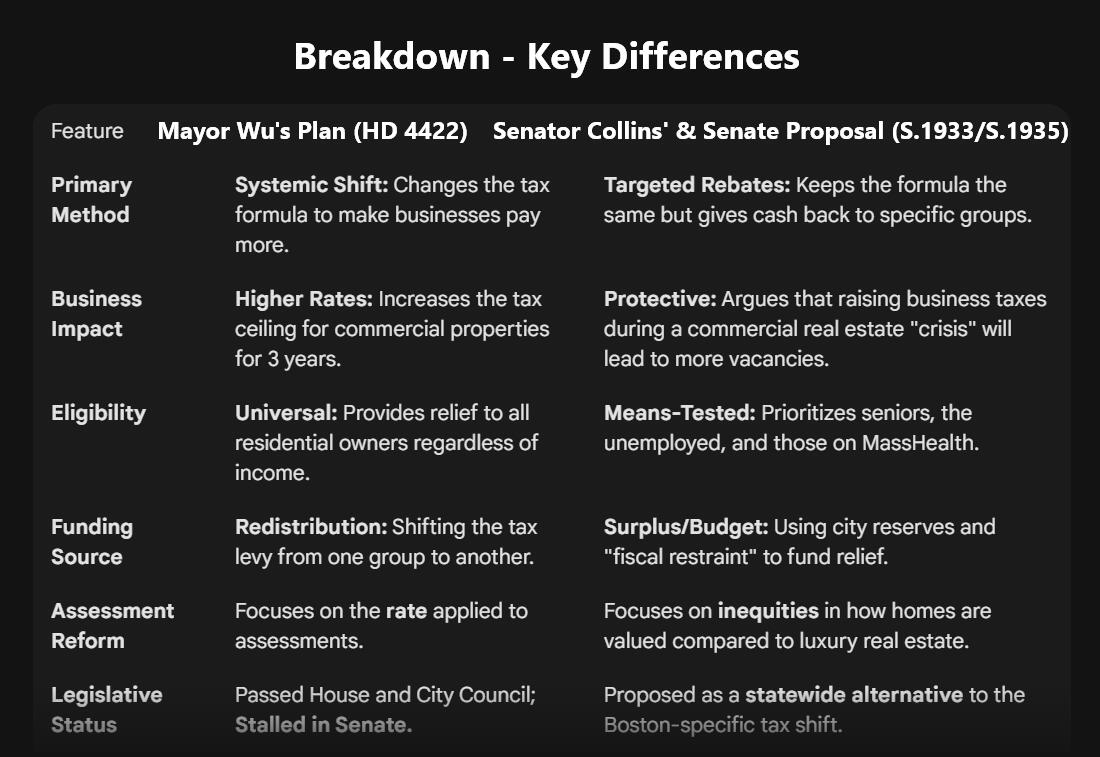
The Bottom Line: The conflict is a choice between two philosophies. Mayor Wu views the property tax spike as an external crisis that requires a structural adjustment to protect the "complexity and diversity" of Boston's neighborhoods.Senator Collins views it as a city management issue, arguing that Boston should use its own massive cash reserves and fix valuation inequities before asking the state to subvert the protections of Proposition 2½As of January 2026, Boston homeowners are facing a significant property tax hike. Because the city-wide tax shift legislation (the "home rule petition") was not passed by the State Senate in late 2025, the burden of declining commercial real estate values has shifted onto residential owners.
Here is how these changes specifically affect your neighborhood and your upcoming bills:The New Tax Rates (FY2026)
The City Council recently finalized the tax rates for the remainder of Fiscal Year 2026.Residential Rate: Increases to $12.40 per $1,000 of assessed value (up from $11.58 last year)Average Increase: The city projects a 13% annual increase for the average single-family home, roughly an extra $780 per year.Impact on Upcoming Quarter (January & April)
The most immediate "sticker shock" occurs in the 3rd Quarter bill (due February 1, 2026).The "Double Jump": Because property valuations are certified in December, the entire annual tax increase is compressed into the final two quarters of the fiscal year.Projected Increase: You will likely see your January bill increase by approximately 26% compared to your October bill. This is not a mistake; it is the "catch-up" payment for the new rate and the updated property assessments.NOTE: While the tax rate is the same city-wide, your specific bill is driven by your home's assessed value. Property valuations are set / determined by the City of Boston Assessing Department. These valuations have risen particularly faster and higher in certain neighborhoods, e.g. Dorchester, South Boston.
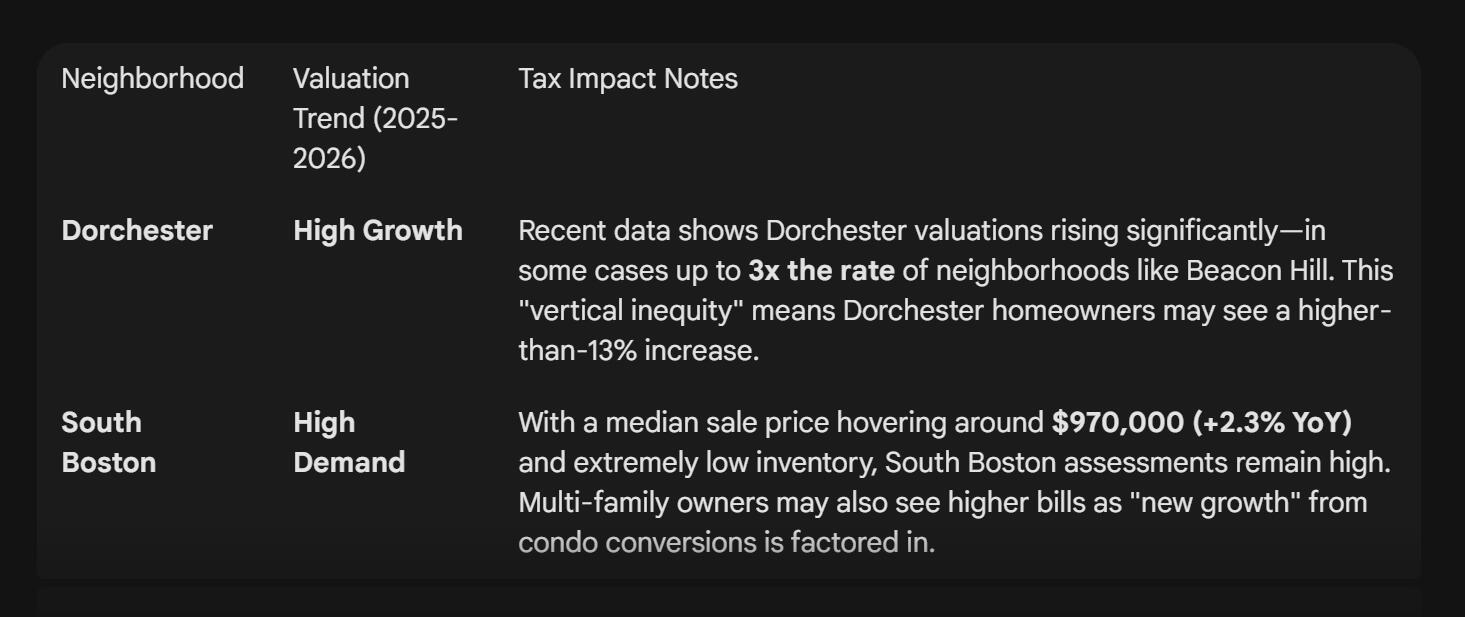
Savings: The Residential ExemptionThe City Council has maintained the 35% Residential Exemption for owner-occupied primary residences.Estimated Savings: Qualified homeowners are expected to save approximately $4,000–$4,200 this year.. Action Needed: If you recently bought your home or don't see the "Residential Exemption" line item on your January bill, you must apply by April 1, 2026.. Note for Landlords: If you own a multi-family home in Boston but do not live there, you do not qualify for the exemption, meaning you will feel the full 13% (or higher) increase on the total assessed value.
Click or tap on images to go to article.


Ruthzee Louijeune

Ruthzee Louijeune was born and raised in the Mattapan section of Boston, and is currently residing in Hyde Park. She is the daughter of working-class Haitian immigrants and a graduate of Boston Public Schools, Columbia University, Harvard Law School, and the Harvard Kennedy School of Government.She is the first Haitian American to be elected to Boston municipal government and to serve as City Council President. Her personal history is a significant part of her platform.Before her time on the City Council, Louijeune worked as an attorney, focusing on issues like housing and voting rights. She has represented families in Boston Housing Court who were facing eviction and foreclosure and has worked with organizations like the Massachusetts Affordable Housing Alliance (MAHA) to expand homeownership opportunities for first-generation buyers. Her legal background provides a foundation for her policy work, particularly on housing affordability.In her Council tenure Louijeune has been a strong advocate for affordable housing and accessible home ownership. She has supported using city-owned land for affordable housing, advocated for a real estate transfer fee to fund housing, and worked on programs to help first-generation homebuyers. She has also supported measures to prevent displacement and help tenants and homeowners facing foreclosure.Louijeune has also prioritized education. She has advocated for teacher diversity, improved school buildings, and increased support services for students, including mental and behavioral health.
Another central theme of her work is addressing systemic racial and economic disparities. She has championed policies to make city contracts more accessible to small, local businesses, and has worked to ensure diverse hiring in the construction industry.Louijeune was unanimously elected by her peers to serve as City Council President. In this role, she has gained a reputation for being a collaborative and thoughtful leader in a body that has at times been divided.Some of her policy priorities on the City Council has focused on several key areas:
. As the former Chair of the Committee on Civil Rights and Immigrant Advancement, she has focused on issues impacting immigrant communities. She has successfully advocated for increased funding for organizations that assist new arrivals and has supported measures to expand voting rights for legal immigrants in city elections.. As a Boston Public Schools graduate, she has prioritized advocating for teacher diversity, improved school buildings, and supportive services for students.
. Her work across various issues, including housing and public health, is rooted in a stated commitment to addressing systemic racial disparities, promoting racial justice and equity.Some accomplishments while in office:
. She has advocated for the expansion of the Office of Returning Citizens, which supports formerly incarcerated individuals.
. She made history as the first Haitian American to be elected to Boston municipal government and the first to serve as President of the City Council.
. A notable accomplishment was her successful leadership of the contentious redistricting process, which passed a new map that met federal court standards and allowed for municipal elections to proceed on schedule.Louijeune has received numerous endorsements from various groups, including the Greater Boston Labor Council, the Boston Teachers Union, and the Sierra Club, indicating support from labor, education, and environmental communities. South Boston Beat recognizes City Councilor Louijeune's proven unflagging dedication, and hard work representing Boston residents.https://www.ruthzeeforboston.com
Erin Murphy

Long-time Boston resident Erin Murphy is a native of Dorchester and a single mother who raised her four children in the neighborhood. This local connection is a central part of her identity as a public servant.She has a background as a Boston Public Schools teacher for over two decades, which has given her a firsthand understanding of the challenges facing families, including educational disparities and economic instability. This experience is a foundation for her advocacy on education reform and public health.A significant part of her public service has been dedicated to public health, specifically substance use disorder and recovery. She has raised funds for recovery services and received awards for her work in this area, including being recognized by the Mayor and the Massachusetts Commission on the Status of Women.Murphy is a registered Democrat, and is generally considered one of the more politically moderate or conservative members of the Boston City Council. She has often been part of a centrist voting bloc that provides a counterpoint to the more progressive members of the council.Her priorities generally focus on constituent services, public health, education, public safety, and affordable housing. She has expressed concern about rising property taxes and has introduced legislation to provide tax relief for seniors and homeowners on fixed incomes.Murphy has emphasized a commitment to transparency and accountability, and accessibility in city government. A core part of her public service has been her focus on being present in every neighborhood and being a "go-to call" for constituents.Listed are some of Murphy's notable votes:Voted against a home rule petition for rent control as it stood.
Voted against a home rule petition to allow non-citizen residents to vote in municipal elections.
Voted against the city's redistricting map in 2022.
Voted against a home rule petition to adopt ranked-choice voting, arguing that the system could be confusing for voters who are not native English speakers.Her strong focus on public safety has earned her endorsements from various law enforcement and first responder unions. She supports policies that are oriented to making Boston's streets safer, including community policing, and has advocated for funding to address gang violence.Murphy has received numerous endorsements from labor and public safetyorganizations, including the Greater Boston Labor Council and AFSCME Council 93, as well as a number of public safety organizations like Boston's four major first responder unions. She has been endorsed by a range of current and former elected officials, including Congressman Stephen F. Lynch, former Mayor Raymond L. Flynn, and a number of state representatives and city councilors.In the 2023 At-Large election, she was re-elected with the second-highest number of votes. South Boston Beat believes that as a result of Councilor Murphy's proven hard work and dedication her numbers will continue to grow.https://erinforboston.com
Julia Mejia

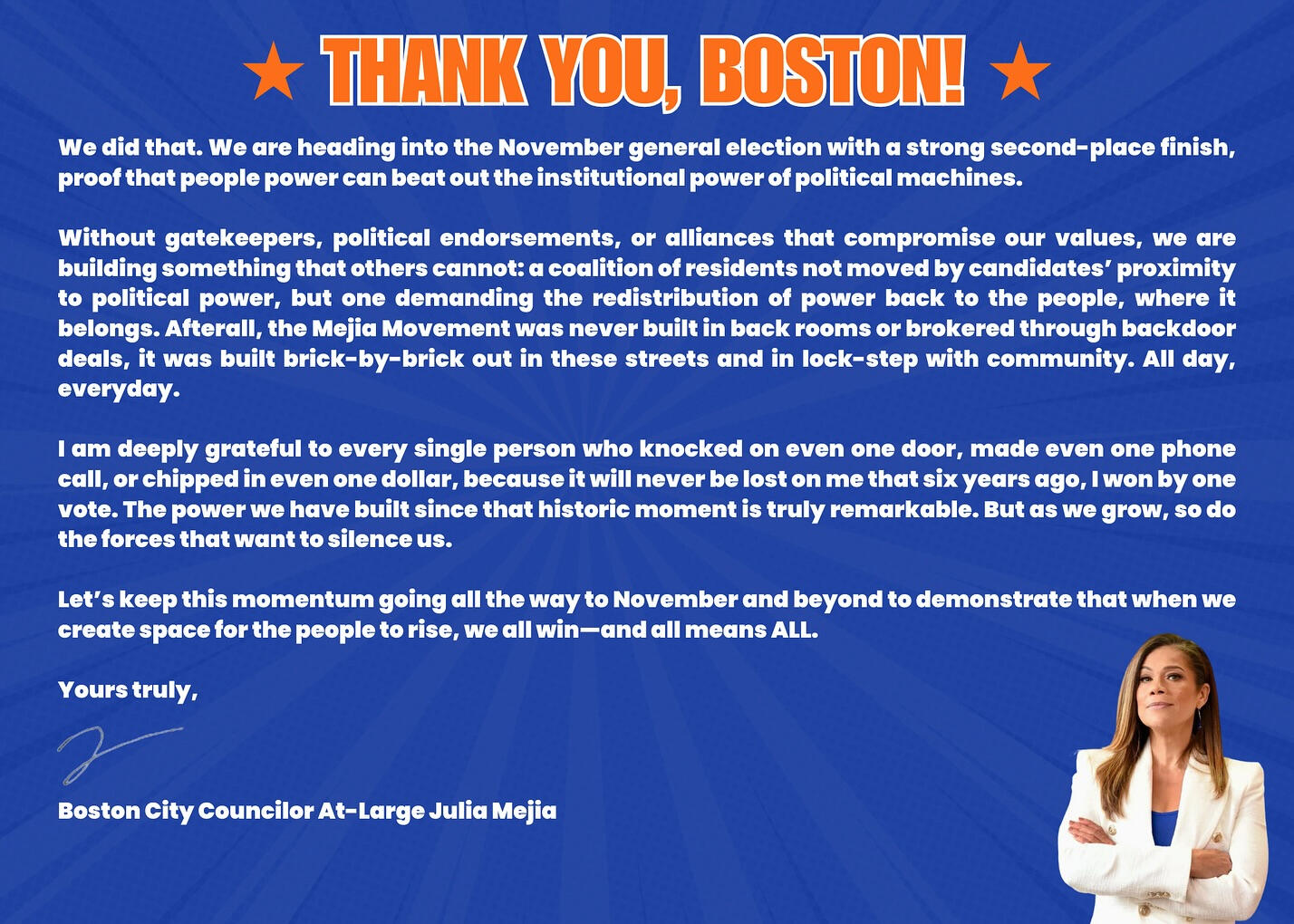
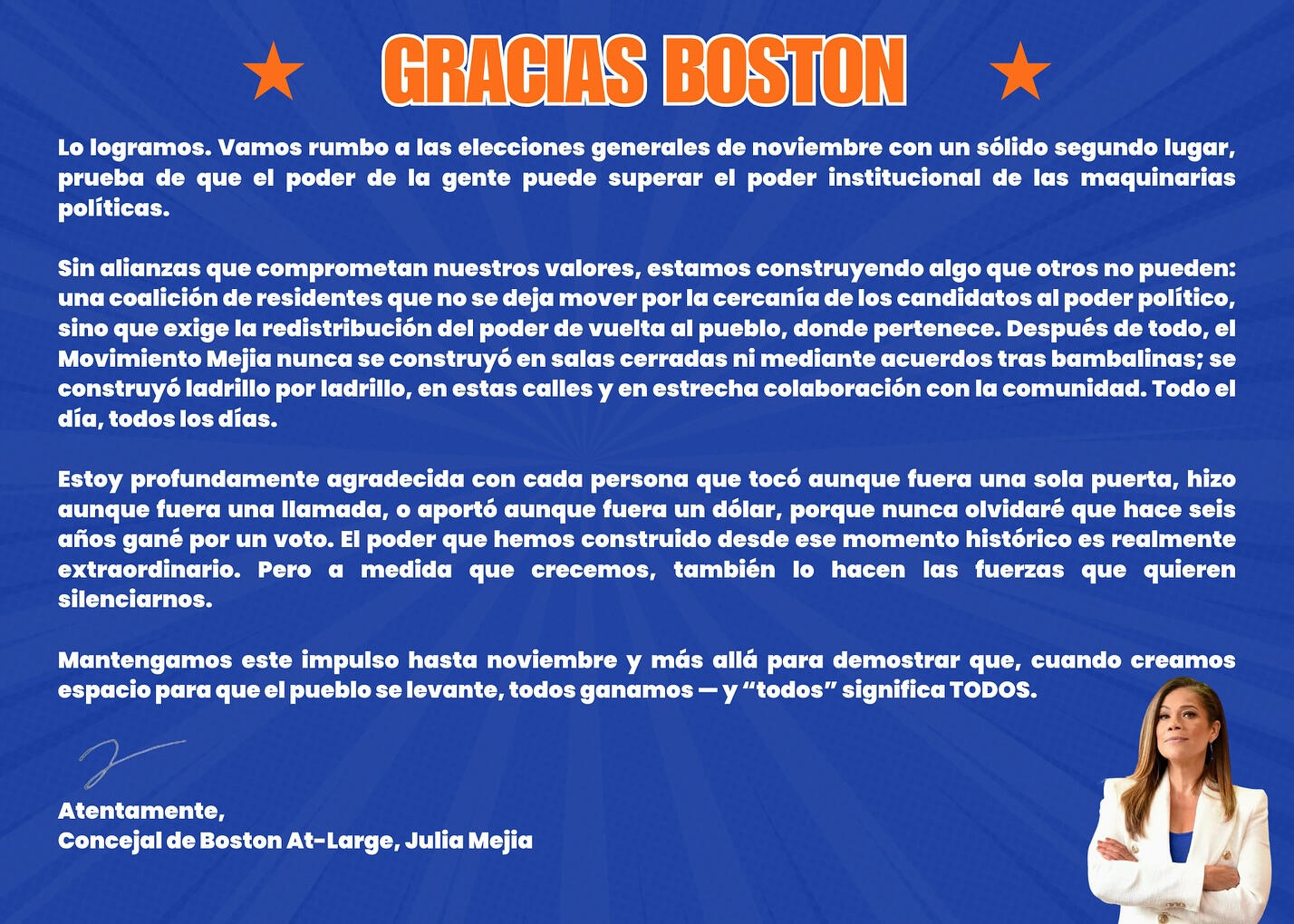
Julia Mejia is an At-Large City Councilor in Boston. Her record and political platform often appeal to voters who prioritize social justice, government accountability, and a community-centered approach to politics.Mejia's personal story is a central part of her public identity. She was born in the Dominican Republic and raised in Dorchester by a single, undocumented mother. This experience, which required her to advocate for her family within various city systems from a young age, has shaped her approach to politics. A tenet of her policy is to ensure that no resident feels ignored by the government that is supposed to serve them.A graduate of Boston Public Schools, she was the first in her family to graduate high school and college. As a Boston Public Schools graduate, Mejia has a strong focus on educational reform. She has advocated for an elected school committee and for a shift in school funding to ensure that all schools have foundational resources like nurses, counselors, and librarians, all to increase resources for students.Before her time on the City Council, Mejia was a community organizer. She founded the Collaborative Parent Leadership Action Network (CPLAN), which focused on empowering families to engage with educational policy. This background is reflected in her "co-governance" philosophy, which seeks to involve residents directly in the policymaking process. She believes in holding government accountable to the people it serves, not just to powerful interests. She is a strong advocate for increasing civic engagement and government transparency.Councilor Mejia has been a vocal advocate for policies aimed at creating a more equitable and accessible city, and has been successful in passing several pieces of legislation. Her major accomplishments include:Promoting Language Access: Mejia led the passage of a Language Access Ordinance that requires all official city information to be available in Boston's top 11 languages, ensuring that more residents can access vital services.Fostering Government Transparency: She created and chairs the Committee on Government Accountability, Transparency, and Accessibility. This committee is dedicated to ensuring that city departments operate with transparency and that their policies and procedures are effective and inclusive.Advancing Diversity and Inclusion: Mejia has been instrumental in the creation of new city offices designed to support marginalized communities, including the Office of Black Male Advancement and the Office of LGBTQIA2S+ Advancement. She also sponsored the Fair Chance Act, which aims to promote diversity in hiring and workplace culture across city agencies.Supporting Small Businesses & Economic Empowerment: She has worked to support small businesses and entrepreneurs from historically marginalized communities. One notable example is the Residential Kitchen Ordinance, which makes it easier for residents to start food businesses from their homes.Prioritizing Youth and Education: Her work has included advocating for more youth engagement in government and addressing issues of social-emotional wellness and violence prevention.Participatory Budgeting: She has been a strong proponent of increasing participatory budgeting, a process that allows residents to directly decide how a portion of the city's budget is spent.Councilor Mejia has established herself as an independent and often progressive voice on the City Council. She has demonstrated a willingness to challenge the status quo and vote against the mayoral administration when she believes it's in the best interest of her constituents. She chairs the City Council's Committee on Government Accountability, Transparency, and Accessibility. This committee is dedicated to ensuring that city departments are held accountable to the public and that government services are delivered equitably across all neighborhoods.South Boston Beat recognizes Councilor Mejia's dedication, perseverance, and powerful voice that she brings to the Council on behalf of the residents of Boston.https://www.juliaforboston.com
Frank Baker

Frank Baker, a long-time Dorchester resident, and former District 3 City Councilor is running for an At-Large seat in the 2025 Boston municipal election. This means he is seeking to represent the entire city, not just a single district. During his time in office, he held several key positions and was involved in various policy and legislative matters.Throughout his six terms (2012 to 2024) Councilor Baker was known for his emphasis on practical, neighborhood-level issues. His ability and "get-it-done" approach to city government, included many works regarding public safety, public health, substance abuse services, education, housing, and economic developmentHe has been a champion for local businesses, and has chaired the City Council's Jobs, Wages, and Workforce Development Committee, focused on issues related to employment and labor.Baker's other committee leadership roles include:. Chair of the Special Committee on Charter Reform: In this role, he proposed extending city councilor terms from two years to four years. His argument was that two-year terms meant council members spent much of their time running for reelection rather than focusing on their duties, and that a four-year term could save the city about $1.6 million by eliminating elections in low-turnout years.. Vice Chair of the Planning, Development and Transportation Committee: Baker was involved in discussions about development and infrastructure projects within his district, including the redevelopment of the former Boston Globe site and a proposed stadium.Legislative Actions and Stances:. Redistricting: Baker was one of four councilors who voted against the city's redistricting map after the 2020 U.S. Census. He took issue with the plan because it altered the shape of his district and split precincts around the Adams Village business area in Dorchester.. Rent Control: In 2023, he and one other council member voted against a home rule petition that would have allowed the city to implement proposals for rent control and reform of the Boston Planning & Development Agency.. Non-citizen Voting: In December 2023, Baker voted against a home rule petition that would have sought state approval to extend voting rights in municipal elections to non-citizen residents with legal status.. Substance Abuse and Housing: He advocated for increased services for substance abuse, including the use of "Section 35" which allows a judge to involuntarily commit someone to treatment for drug or alcohol use.In addition to his legislative roles, Baker focused on constituent services. He was involved in a project to bring a new fieldhouse to Dorchester in partnership with the Martin Richard Foundation and the Boys & Girls Clubs.He also previously proposed shifting the City Council's term length from two years to four years to allow councilors to focus more on their work rather than on constant campaigning.This experience gives him a deep understanding of City Hall operations, budgeting, and the legislative process. Throughout his tenure, he was known for being a more moderate or conservative voice on the Council, often standing apart from the more progressive majority. For a voter who believes the council needs a greater diversity of political perspectives, Baker's candidacy offers an opportunity to add a centrist voice to the at-large body.Baker has been described as one of the more conservative or centrist members of the City Council. He has often been a lone "no" vote on measures supported by the more progressive wing of the council. For voters who feel the current council has moved too far to the left, Baker represents a potential counterbalance and a voice for more moderate policies.Baker built a reputation for being accessible and responsive to neighborhood-level concerns, from constituent services to local development projects. For voters who value a candidate who is focused on the practical, day-to-day issues affecting residents, his record as a district councilor is a strong indicator of his approach to an at-large position.After choosing not to run for reelection in 2023, Baker stated that he was now "answering the call" from Bostonians who urged him to return to public service.South Boston Beat recognizes his past service and accomplishments in the Council. Frank's proven reputation as an independent voice on the City Council makes him a much needed component to the Council moving forward.https://www.bakerforboston.com
